That's a Wrap: A Summer of Learning with the SPRINT Project Team

Reflections on Learning From Our Recent Internship and Placement Students
The SPRINT Project is fortunate to work with talented students from a range of disciplines and backgrounds through internships and placement opportunities. These experiences are an important part of our commitment to developing the next generation of researchers, practitioners, and professionals who are passionate about improving wellbeing in sport, dance, physical activity, and performance settings. Students bring fresh perspectives, curiosity, enthusiasm, and valuable skills to our team.
During their time with the SPRINT Project team, they contribute to a wide range of activities, including developing knowledge exchange materials, creating blogs and infographics, supporting reports and resources, and helping us communicate research findings to diverse audiences. Their contributions help us extend the reach and impact of our work while ensuring that important research is accessible beyond academic settings.
In return, we hope to provide opportunities for students to develop research, communication, and professional skills, gain experience of working within an interdisciplinary research team, and explore how evidence can be translated into meaningful real-world impact. One of the most rewarding aspects of working with students is seeing their confidence grow as they engage with new topics, develop new skills, and discover connections between their studies and future careers.
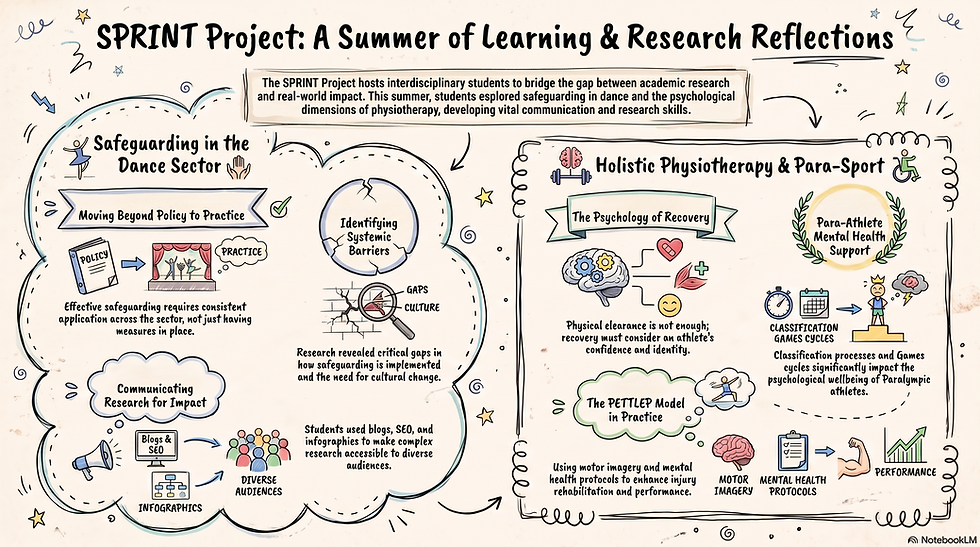
Over the past few weeks, our recent micro-interns and physiotherapy placement students have explored topics ranging from safeguarding in dance to athlete mental health, injury rehabilitation, and wellbeing in Paralympic sport. Along the way, they have written blogs, created infographics, contributed to research activities, and reflected critically on the implications of research for practice.
As their placements and internships come to an end, we invited them to share some reflections on what they learned, what surprised them, and what they will take forward into their future studies and careers. We are incredibly grateful for the energy, thoughtfulness, and enthusiasm they brought to the SPRINT team, and we are delighted to share their reflections with you.
Future Focused Micro Internship Students: Aleksandra and Hazera
During our time in this internship, we have explored research in dance and safeguarding, gaining knowledge in the importance of safeguarding and abuse prevention but also the barriers of implementing such safeguarding policies and procedures and how this can be changed. We have been able to actively contribute to the reporting of such findings, through creating blogs about the different topics in an engaging manner.
We would like to share our reflections as this internship comes to a close, about what we have learnt during this time and what we will take away from this experience. Please take the time to read our individual reflections of our experience working with the SPRINT project.

Hazera
Reflecting on my 2-week internship with the SPRINT Project, I have thoroughly enjoyed participating in collaborating with the research findings. This research has opened my eyes to the many negative experiences dancers may face such as the psychological, sexual and physical abuse that is prominent in this industry. I have learnt so much about the dance sector, particularly how important safeguarding and abuse prevention is for the safety of dancers.
I have always had an interest and passion for mental health and the wellbeing of people, so gaining a deeper insight in the dance industry has really enhanced my passion for mental health and the importance of it. During this experience I have also learnt a variety of new skills, such as writing blogs, creating infographics and I have learnt new terms such as meta-synthesis and SEO terms which are important for capturing interest for several audiences. I have also had the chance to draft my own blog about ‘Why safeguarding still fails: a system’s perspective’.
You can read Hazera's blog post on why safeguarding still fails: a system’s perspective here.
I am leaving this internship feeling more passionate and curious about how wellbeing is managed in other industries that are not mainstream like dance, especially within regulating and protecting the wellbeing of people involved. I am grateful for this opportunity to contribute to such meaningful and insightful research and to develop new skills that will be used throughout my future career, whatever it may be.
Aleksandra
As I finish my two-week internship with the SPRINT Project, I've been reflecting on everything I've learned. Coming from a psychology background, I knew very little about the dance sector. This experience has emphasised how unregulated dance is and the crucial role safeguarding plays in protecting dancers.
Throughout this opportunity, I've had the chance to write a blog post titled ‘What good safeguarding looks like in dance: Moving beyond policy to practice’. Researching and writing this post illustrated that safeguarding isn't just about having measures in place but also about applying them consistently across the sector, from policymakers to dance influencers.
You can read Aleksandra's blog on what good safeguarding looks like in dance: moving beyond policy to practice here.
Alongside this, I drafted an infographic, a LinkedIn post, SEO terms, and a meta synthesis for the blog. These were all new tasks for me, and I enjoyed learning how to apply them to support engagement and communicate the work more effectively. I also contributed to the upcoming report on the 2nd National Survey of Safeguarding and Abuse Prevention in Dance, which introduced me to the ongoing gaps in safeguarding policy implementations and the need for system-wide action and cultural change across dance organisations.
Throughout this internship, I've strengthened my research skills as well as my teamwork and time management. This experience has also deepened my interest in wellbeing and community-focused research. I am leaving this internship with new skills, greater confidence, and an enthusiasm to carry these insights into future job opportunities.
Thank you so much for creating such valuable and insightful experiences during our time in the future focused micro-internship and allowing us to be contribute to such meaningful research. We have enjoyed our short but memorable time working with the SPRINT project, in particularly with Prof Jennifer Cumming. We leave this experience with more knowledge, new skills and greater enthusiasm to pursue further opportunities.
Thank you.
Hazera and Aleksandra
MSc Physiotherapy Placement Students: Alex and Hank
Six weeks ago, we joined the SPRINT Project for our research placements, curious about what sport psychology research could offer to our training as physiotherapists. During this time, we have had the opportunity to explore a range of topics relating to sport, psychology, and athlete wellbeing, including the mental health support of Paralympic athletes, while developing our research, communication, and professional skills. From reviewing literature and contributing to research projects to writing blogs on topics that interested us, this placement has provided valuable learning experiences that will support our future careers in physiotherapy.
As our placement comes to an end, we wanted to take some time to reflect on our experiences, share what we have learned, and discuss how these lessons may influence our future practice. Read on to hear our individual reflections from our time with the SPRINT Project.

Alex
Reflecting on my six-week placement with the SPRINT team, I have thoroughly enjoyed contributing to research on para-athlete mental health and wellbeing. Coming from a physiotherapy background, I began this placement already familiar with the physical side of athlete care, but this experience opened my eyes to how central psychological wellbeing is to holistic performance and rehabilitation, especially within a population as underrepresented in research as Paralympic athletes.
During this placement, I researched and wrote blog posts on topics including pitch-side mental health care and the use of motor imagery in athlete detraining, drawing on frameworks like the PETTLEP model to translate research into practical guidance for practitioners.
I also gained a much clearer understanding of how mental health support is being built into elite sport systems, from pitch-side protocols to Games cycle planning for Paralympic athletes. I will carry this insight directly into my physiotherapy practice, where recognizing the psychological dimension of injury, rehabilitation, and return to play is just as important as the physical one.
This placement has reinforced how much physiotherapy sits at the intersection of physical and psychological care, and it has sharpened my interest in pursuing a career in high-performance sports medicine, where both are treated as equally essential. I am leaving with stronger research and communication skills, a better understanding of interdisciplinary, multi-professional collaboration, and real enthusiasm to keep applying these insights as I continue toward a career in sports and MSK rehabilitation.
Hank
Looking back on my six-week placement with the SPRINT Project, I have gained a much broader understanding of the relationship between physical rehabilitation, psychological wellbeing, and athlete performance. Before starting the placement, my physiotherapy training mainly focused on physical assessment and treatment. This experience showed me that recovery cannot be fully understood without also considering an athlete’s confidence, emotions, identity, and wider support environment.
During the placement, I researched and wrote two blog posts on topics that were particularly relevant to physiotherapy practice. My first blog explores the psychological challenges athletes may experience when returning to sport after an ACL injury. It focused on issues such as fear of reinjury, reduced confidence, and psychological readiness, highlighting why physical clearance alone does not always mean that an athlete feels ready to compete again. The blog also considered how athletes, coaches, and healthcare professionals can work together to support a safer and more confident return to sport.
You can read Hank's blog post on supporting athletes to return to sport after ACL injury here.
My second blog examined the relationship between classification and mental health in Para sport. Through reviewing literature, I learned that classification is not simply a technical or administrative process. Uncertainty, reclassification, and the possibility of being found ineligible may affect athletes’ confidence, sporting identity, career plans, and psychological wellbeing. This work helped me better understand the experiences of Paralympic athletes and the importance of providing clear information, accessible communication, and appropriate emotional support throughout the classification process.
You can read Hank's blog post on classification in Para sport here.
Alongside writing the blogs, I contributed to a wider review of mental health support for Paralympic athletes across the Games cycle. This involved identifying findings from the literature, organizing evidence into key themes, and helping to develop practical guidelines. It strengthened my ability to critically review research and translate academic evidence into recommendations that may be useful for athletes, practitioners, and sporting organizations.
The placement has also improved my communication, teamwork, and professional skills. I have become more confident in presenting in a clear and accessible way, rather than only using academic language. Most importantly, I will take forward a more holistic approach to physiotherapy practice. Whether supporting an athlete after injury or working with people from different sporting and disability backgrounds, I will be more aware of the psychological and social factors that may influence rehabilitation.
I am grateful for the opportunity to contribute to the SPRINT Project. The placement has encouraged me to remain curious, consider the person behind the injury, and continue developing as an evidence-based and compassionate physiotherapist.
Overall, our time with the SPRINT Project has helped us recognize that effective physiotherapy involves much more than addressing physical symptoms alone.
Although we explored different topics during the placement, our work shared a common message: psychological wellbeing should be considered alongside physical health in both research and clinical practice. The placement has strengthened our ability to review evidence, communicate research to different audiences, and translate academic findings into practical recommendations.
As we move forward in our physiotherapy training, we will carry these lessons into our future practice. We hope to approach each client as a whole person, work effectively with professionals from different disciplines, and contribute to rehabilitation environments in which both physical recovery and psychological wellbeing are treated as essential.
Thank you to the SPRINT Project team, and particularly Prof Jennifer Cumming and Dr Georgia Bird, for such a valuable and insightful placement experience.
Working with students is one of the most rewarding aspects of the SPRINT Project. We are grateful for the energy, insight, and fresh perspectives that our interns and placement students bring to the team, and we have thoroughly enjoyed supporting their development over the past few weeks. As Hazera, Aleksandra, Alex, and Hank move on to the next stage of their studies and careers, we would like to thank them for their enthusiasm, curiosity, and thoughtful contributions to the SPRINT Project.
Supporting emerging researchers and practitioners is an important part of our work, and it has been a pleasure to see their confidence, skills, and understanding develop over the course of their placements and internships. We hope these experiences have provided a valuable foundation for their future careers, and we look forward to following their continued achievements in the years ahead.
Post written by Prof Jennifer Cumming, Hazera Begum, Aleksandra Ogorek, Alex Wakim, and Hank Zhao. The infographic was created using Notebook LM.


Comments